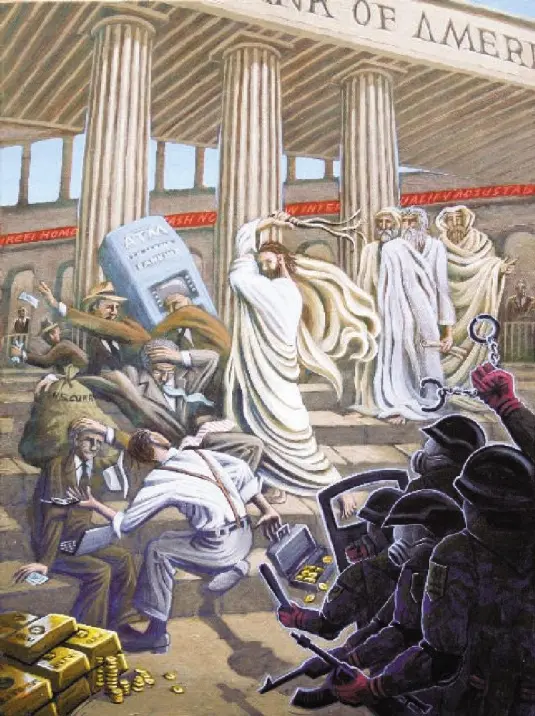
Image: “Bad Day on Wall Street,” Russell Brutche, used by permission
Lenten Series: #5, A Spiritual Foundation for Resistance to Empire
This post includes excerpts from “Chapter 5: Jesus and the Powers,” in Sharon’s book, The Cross in the Midst of Creation.
Jesus, Resister: Palm/Passion Sunday
All four Gospels portray the religious leaders criticizing Jesus’s actions and putting him to the test throughout his ministry. They not only took Jesus’s actions as a personal affront to their privilege but also believed that they were in the right and were carrying out God’s Law. Not all members of the religious establishment were against Jesus, but as a ruling council, they opposed him because he was subverting their authority and they were responsible to keep the peace during the Roman occupation.
These conflicts between Jesus and the authorities illustrate the direct challenge he posed to the domination system by revealing the compassionate nature of God and by creating a popular alternative community that was inclusive, equitable, and noncoercive. By doing so, Jesus challenged the religious hierarchy, the reign of Herod, and the overarching rule of Caesar. These conflicts continued and intensified throughout his ministry, leading to the final confrontation between Jesus and the powers. As the story progresses, the tension builds and the plot thickens as Jesus heads for Jerusalem, deliberately planning his time there to coincide with the observation of Passover.
When considering what to do about Jesus, the chief priests and Pharisees held a meeting of the ruling council. They said, “If we let him go on like this, everyone will believe in him, and the Romans will come and take away both our holy place and our nation.” Then Caiaphas, the high priest, said, “You do not understand that it is better for you to have one man die for the people than to have the whole nation destroyed” (John 11:50). They used their religious power and privilege to justify turning Jesus over to be crucified for the sake of national security.
Although the religious leaders were already looking for a way to kill Jesus, they were enraged when Jesus carried out two back-to-back demonstrations in the days leading up to Passover. The first has been called the “triumphal entry into Jerusalem.” He entered the city on a donkey’s colt, where crowds of people joyfully welcomed him, shouting “Hosanna,” waving palm branches, calling him the “son of David,” and throwing their cloaks on the ground in front of him.
While this humble procession demonstrated the form of “kingship” that Jesus embraced, it can also be understood as a parody of the annual Roman procession that would soon be entering Jerusalem to keep the peace during Passover, with its elaborate display of chariots, banners, and other symbols of empire. Jesus’s Palm Sunday procession was a highly symbolic demonstration that highlighted the contrast between these two conflicting kingdoms: the kingdom (or empire) of Caesar and the kingdom of God.
Then, in Jerusalem, Jesus overturned the tables of the moneychangers in the temple and drove out those who were conducting business there. This action by Jesus has been called the “cleansing of the temple,” but it was actually a symbolic action directed against the idolatrous and unjust economic system through which the religious establishment upheld the Roman occupation. This action challenged the legitimacy of the religious establishment’s collaboration with Roman rule and further solidified the plans of the religious leaders to have Jesus killed. Some have called this temple action an exorcism. According to Walter Wink,
The paradigmatic collective exorcism in the New Testament is Jesus’ cleansing of the temple. . . . This act is depicted by the Synoptic Gospels as the climax of his ministry, the central focus of his journey to Jerusalem, and the final provocation of his arrest and execution. . . . Each account, even John’s, uses the formulaic term for exorcism, ekballo, to describe his act of “driving out” those who did commerce in the temple.
This act of “exorcism” at the temple does not contradict the claim that Jesus practiced active nonviolence. In fact, it is an example of what today might be called nonviolent direct action. This contemporary term refers to a symbolic or strategic action undertaken directly by individuals or groups to bring about social change through nonviolent means. Both Mohandas Gandhi and Martin Luther King Jr. pointed to Jesus as the inspiration for their campaigns of nonviolent action.
In his action at the temple, Jesus drove out both people and animals and created disarray, but he did not harm or intend to harm anyone. In fact, according to John, after the confrontation, Jesus stayed and cured people who came to him there in the temple, including some who had been blind or unable to walk. According to Matthew, what seems to have enraged the religious leaders most was that children in the temple area continued calling out, “Hosanna to the Son of David” (Matt 21:14– 16). Because large and enthusiastic crowds responded to Jesus’s message, the authorities believed that the growing popularity of this movement presented a dire threat to the stability of the whole interlocking network of institutional powers. The authorities clearly felt increasingly threatened as the movement grew, and they became more determined than ever to do away with Jesus, just as oppressive governments do today by targeting movement leaders when “people power” threatens the stability of the status quo.
Following this pivotal nonviolent direct action, Jesus and his disciples occupied the temple area each day, like activists today who “occupy” a center of power. “Every day he was teaching in the temple” (Luke 19:47), to the dismay of the chief priests and scribes, who did not want to arrest him during Passover because they feared that “there may be a riot among the people” (Mark 14:1– 2). Every night Jesus would go out to the Mount of Olives, but “all the people would get up early in the morning to listen to him in the temple” (Luke 21:37– 38). By then, the power of the people had become evident. The authorities were looking for a way to put Jesus to death, “but they feared the people” (Luke 20:19; 22:2); they could not get near Jesus to arrest him, “because the whole crowd was spellbound by his teaching” (Mark 11:18).
These stories, which we remember every year, are a reminder of the power that we have to rise up nonviolently in resistance to the powers of our day. By reflecting on the life, teachings, and example of Jesus, even when he faced persecution, torture, and death, we can be inspired to follow his example and put our faith in God, who brings light out of darkness and light out of death.
This is post #5 of Sharon’s 2026 Lenten Blog Post Series: A Spiritual Foundation for Resistance to Empire. See the other posts in the series here.
This post includes excerpts from “Chapter 5: Jesus and the Powers,” in Sharon’s book, The Cross in the Midst of Creation. The newly revised edition of her book Love in a Time of Climate Change is also now available.
Subscribe to receive Sharon’s blog posts by email or follow her on Social Media below. Contact Sharon to request a free chapter of one of her books, to schedule a presentation, or to order discounted bulk copies of her books. Discussion guides and video introductions to her books are also available.
#cleansingthetemple, #palmsunday, #triumphalentryintojerusalem, #jesusresister, #nonviolentresistance, #Jesus, #nonviolentdirectaction, #palm/passionsunday, #lent, #thelastweek,
Comments