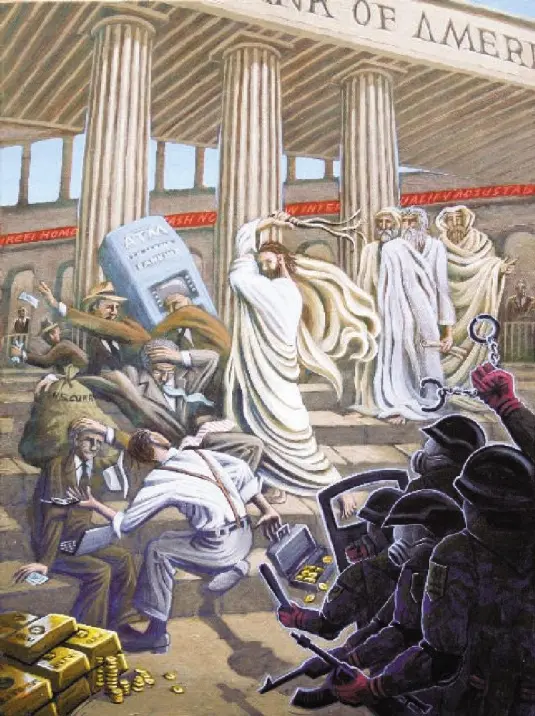
“Bad Day on Wall Street” by Russell Brutsche, used with permission
Here we go further in this Holy Week Series, “Why Did Jesus Die: The Story Without the Dogma,” about what led up to Jesus’ death and post-death appearances. My previous post highlights Jesus’s entry into Jerusalem as a demonstration of An Alternative to Empire. Today we look at a second demonstration that Jesus led, which further enraged the religious and political authorities.
In Jerusalem, Jesus overturned the tables of the moneychangers in the temple and drove out those who were conducting business there. This action by Jesus has been called the “cleansing of the temple,” but it was actually a symbolic action directed against the idolatrous and unjust economic system through which the religious establishment upheld the Roman occupation. This action challenged the legitimacy of the religious establishment’s collaboration with Roman rule and further solidified the plans of the religious leaders to have Jesus killed. Some have called this temple action an exorcism. According to Walter Wink:
The paradigmatic collective exorcism in the New Testament is Jesus’ cleansing of the temple. . . . This act is depicted by the Synoptic Gospels as the climax of his ministry, the central focus of his journey to Jerusalem, and the final provocation of his arrest and execution. . . . Each account, even John’s, uses the formulaic term for exorcism, ekballo, to describe his act of “driving out” those who did commerce in the temple. (Walter Wink, Unmasking the Powers, page 65.)
This act of “exorcism” at the temple does not contradict the claim that Jesus practiced active nonviolence. In fact, it is an example of what today might be called nonviolent direct action. This contemporary term refers to a symbolic or strategic action undertaken directly by individuals or groups to bring about social change through nonviolent means. Both Mohandas Gandhi and Martin Luther King Jr. pointed to Jesus as the inspiration for their campaigns of nonviolent action.
In his action at the temple, Jesus drove out both people and animals and created disarray, but he did not harm or intend to harm anyone. In fact, according to John, after the confrontation, Jesus stayed and cured people who came to him there in the temple, including some who had been blind or unable to walk. According to Matthew, what seems to have enraged the religious leaders most was that children in the temple area continued calling out, “Hosanna to the Son of David” (Matt 21:14– 16). Because large and enthusiastic crowds responded to Jesus’s message, the authorities believed that the growing popularity of this movement presented a dire threat to the stability of the whole interlocking network of institutional powers. The authorities clearly felt increasingly threatened as the movement grew, and they became more determined than ever to do away with Jesus, just as oppressive governments do today by targeting movement leaders when “people power” threatens the stability of the status quo.
Following this pivotal nonviolent direct action, Jesus and his disciples occupied the temple area each day, like activists today who “occupy” a center of power. “Every day he was teaching in the temple” (Luke 19:47), to the dismay of the chief priests and scribes, who did not want to arrest him during Passover because they feared that “there may be a riot among the people” (Mark 14:1– 2). Every night Jesus would go out to the Mount of Olives, but “all the people would get up early in the morning to listen to him in the temple” (Luke 21:37– 38). By then, the power of the people had become evident. The authorities were looking for a way to put Jesus to death, “but they feared the people” (Luke 20:19; 22:2); they could not get near Jesus to arrest him, “because the whole crowd was spellbound by his teaching” (Mark 11:18).
In our day, we have seen what happens when people stand against oppression. Sentences and fines have been getting more punitive in recent years, including against environmental activists, sometimes labeled as terrorists. Many universities have cooperated in sanctioning students who protest, denying their freedom of speech. Now, under the Trump Administration, sanctions against have become extreme and have included deportation of foreign students.
As in so many stories about Jesus in the Gospels, the story of Jesus’ struggle against the “Pax Romana” of his day can inspire and motivate us to do our part to resist the “Pax Americana” as it reveals itself to be–a system that causes extreme harm to human beings and to the community of all creation. This story is also a reminder that even while resisting the harm, our focus can be on the teachings and example of Jesus, which put everything in perspective.
This post is second in the Holy Week 2025 Series: “Why Did Jesus Die: The Story Without the Dogma.” See also Palm/Passion Sunday: An Alternative to Empire. This series is based on Sharon Delgado’s book, The Cross in the Midst of Creation: Following Jesus, Engaging the Powers, Transforming the World.
Follow Sharon’s blog post by signing up at the “Follow” link to the right. Share with the Social Media buttons below. Read other blog posts related to climate change here. Check out Sharon’s books. Contact Sharon to request a presentation or to order discounted bulk copies of her books. Discussion guides and video introductions of her books are also available.
Comments
4 responses to “The Cleansing the Temple: Direct Action as Exorcism”
[…] Holy Week 2025 Series: “Why Did Jesus Die: The Story Without the Dogma.” See also The Cleansing of the Temple: Direct Action as Exorcism and Palm/Passion Sunday: An Alternative to […]
[…] Die: The Story Without the Dogma.” See also Palm/Passion Sunday: An Alternative to Empire, The Cleansing of the Temple: Direct Action as Exorcism and Maundy Thursday: Gethsemane and the Will of […]
[…] Die: The Story Without the Dogma.” See also Palm/Passion Sunday: An Alternative to Empire, The Cleansing of the Temple: Direct Action as Exorcism, Maundy Thursday: Gethsemane and the Will of God, and Good Friday: Not a Transaction. This series […]
[…] Die: The Story Without the Dogma.” See also Palm/Passion Sunday: An Alternative to Empire, The Cleansing of the Temple: Direct Action as Exorcism, Maundy Thursday: Gethsemane and the Will of God, and Good Friday: Not a Transaction, and Holy […]