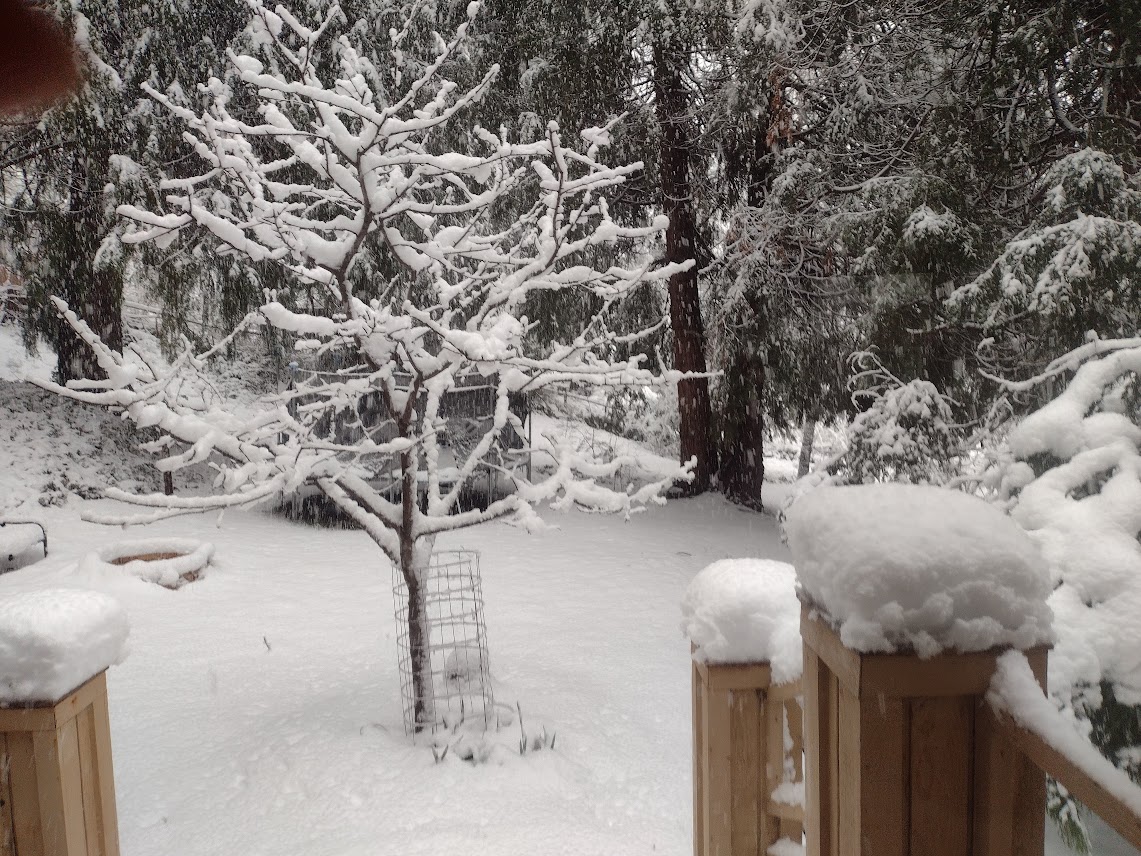
Cherry tree in late snow, image by Sharon Delgado
Lenten Blog Series 2026: Spiritual Foundations for Nonviolent Resistance to Empire
Second Sunday in Lent: The God Who Creates is the God Who Saves
“I lift up my eyes to the hills—from where will my help come? My help comes from the Lord, who made heaven and earth.” —Psalm 121:1–2
As we look to God for help at this time when multiple social and ecological crises face our human family, it’s clear to see that we human beings don’t have the wisdom or power to bring about the profound changes that are required. Still, we are called to live by the Spirit and do our part to bring about creation’s healing and transformation
Theologians who seek to be faithful to this call have been working for decades to articulate a theology of creation that will motivate creation care. The biblical term stewardship is often used to express human responsibility to care for the natural world, based on the idea that all things belong to God and that we are merely stewards of creation. Biblical passages that reinforce calls for environmental stewardship include the claim that “the earth is the Lord’s and all that is in it” (Ps 24:1) and the statement that “the Lord God took the man and put him in the garden of Eden to till it and keep it” (Gen 2:15), thus portraying the human vocation as stewards of the land.
However, in this time of extreme ecological devastation, the concept of environmental stewardship has limited value. Although this well-meaning concept calls for responsibility and care for the earth, it reinforces the anthropocentric concept of human dominion over the natural world (Gen 1:26) and leaves intact the view that humans are somehow above and separate from the natural world. To some this suggests that the universe was created for and is centered on human beings, an idea that ignores our interrelatedness with all parts of creation. This devalues the rest of creation and sanctifies hierarchical ideas that have led to widespread ecocide.
There are other scriptural themes that can help guide us as we seek to follow Jesus in this time of ecological destruction. Psalm 104 offers a vision of interrelated ecosystems in which God provides sustenance (food, water, and habitat) to all parts of creation, including human beings. Psalm 148 presents human beings, along with all other members of the community of life, praising God together. Psalm 121, including the excerpt quoted above, is one of today’s suggested lectionary passages. It makes clear that our help is in God, who made heaven and earth, and that the God who creates and the God who saves are one and the same.
Lent is a time for reflection on the meaning of the life and teachings, death and resurrection of Jesus and how it relates to our time. Yet as we reflect on the crucifixion of Jesus two thousand years ago, we must also recognize how creation is being crucified in our day. The ecological balance we have enjoyed throughout human history, with its predictable natural processes and a relatively stable climate, is being disrupted. The interdependent web of life that sustains and constitutes human life is being unraveled, accompanied by simultaneous social breakdown.
This does not bode well for humans or for other life-forms with whom we share the earth. Life is being diminished–signs of death are all around. Many people around the world are grieving for the profound loss that this represents. This is not taking place in a vacuum, nor is it part of an inevitable natural process. Rather, it is the direct and predictable result of a human-constructed global system of institutional powers that has grown beyond human control and has taken on a life of its own. Its underlying assumptions, institutions, and operating systems function efficiently to enslave humans in their service and devour the gifts of the earth to bring profit, prestige, and power to the elite few. The air, water, land, and stable climate necessary for sustaining life are being destroyed by the institutional imperatives of today’s corporate-dominated global empire. This cannot be the plan or design of the God of love, the God who creates, the God who saves. Creation itself is being crucified.
Christians who have been working to incorporate concern for creation into church ministries seek to craft a message that will motivate churches to practice creation care in a significant way. Our hope is that by recognizing the intrinsic value of creation, people will treat the natural world with the care that it deserves. This is important work.
However, simply knowing or caring about something does not always change human behavior.
Eco-theology and creation care are not enough. We cannot bypass the pain of “the cross in the midst of creation” with the soft message of creation care. Creation theology and a theology of the cross belong together. As we weather the storms of ecological degradation, inequity and injustice, famine, displacement, violence, genocide, war, and the literal storms of a rapidly destabilizing climate, the church of Jesus Christ must proclaim the full gospel in a way that is relevant for today, focusing on the story of Jesus, the ongoing suffering of Christ in creation, the powers responsible for Jesus’s death and for creation’s devastation today, and God’s redemptive power to bring life out of death and to make a way where there is no way, sometimes through us.
God’s presence extends in and through the vastness of all time and space, and here we are, born into this particular time and place. This is significant. The earth is our home—the only home we have. This is our time—the only time we have in which to act on behalf of life. In the words of Paul, “‘At an acceptable time I have listened to you, and on a day of salvation I have helped you.’ See, now is the acceptable time; see, now is the day of salvation!” (2 Cor 6:2).
We certainly need to be saved. But what does salvation look like in this context? It cannot mean simply saving individual people out of this world and leaving everyone else to live on a progressively degraded earth. Surely the God who created abundant life wants it to continue and flourish. Salvation must include release from the apathy, moral confusion, and hopelessness that characterize our time. It must mean personal transformation that gives us hope and equips us for loving action in the world, for God’s intention is the liberation and reconciliation of all creation.
This is not the end of the story. For the God who creates is also the God who saves, and all creation is included in the saving grace of God.
This post includes excerpts from “Chapter 4: Creation Crucified, The Passion of the Earth” in Sharon’s book, The Cross in the Midst of Creation. The newly revised edition of Love in a Time of Climate Change is also now available.
Subscribe to receive Sharon’s blog posts by email or follow her on Social Media below. Contact Sharon to request a free chapter of one of her books, to schedule a presentation, or to order discounted bulk copies of her books. Discussion guides and video introductions to her books are also available.
#creationcare, #cross, #creationcrucified, #passionoftheearth, #crossinthemidstofcreation, #creationtheology, #theologyofthecross, #lent, #secondsundayinlent, #ecocide, #Jesus, #sharondelgado
Comments